NAPIM

Printing Inks Containing Titanium Dioxide

November 23, 2022 EU Court of Justice of the European Union Annuls TiO2 Carcinogen Classification

In a ruling dated November 23, 2022, the General Court annulled the Commission Delegated Regulation of 2019 (Regulation 2020/217,) in so far as it concerns the harmonized classification and labeling of titanium dioxide as a carcinogenic substance by inhalation in certain powder forms (powder form containing 1% or more of particles of a diameter equal to or below 10 μm.). NAPIM statement here. A copy of the EU Court of Justice decision can be found here2020 NAPIM Statement on TiO2 carcinogen classification – applicability to printing inks.

Background

On February 18, 2020, the European Union published a delegated regulation classifying titanium dioxide (TiO2) as a category 2 suspected carcinogen by inhalation1. This classification is applicable to facilities handling/processing or selling dry, powder titanium dioxide where there is a potential for the evolution of TiO2 particulates. Please note that Section 2.1.2 – mixtures containing titanium dioxide of the regulation addresses mixtures containing 1% or more of titanium dioxide. This section applies to TiO2-containing spray applications where respirable droplets are possible and operations (using mixtures) where TiO2 dust is evolved.

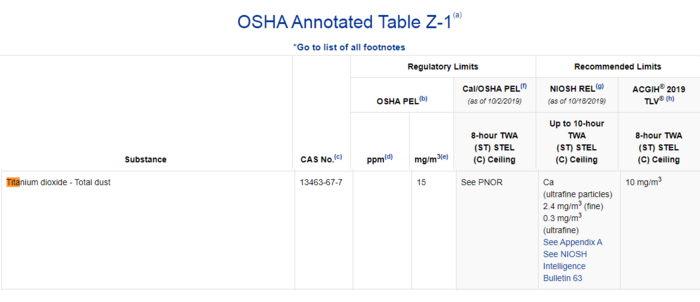
The US Occupational Safety and Health Administration (OSHA) has not changed its existing TiO2 classification.

The integration of the Globally Harmonized System into the OSHA Hazard Communication Standard (29CFR1910.1200) substantially revised the physical and health hazard classification procedures – Appendices A and B of the Standard. It is important to note that the majority of the regulatory basis for the standard has not changed. OSHA still requires “potential for exposure” under the Scope and Application (29CFR1910.1200(b)) of the Hazard Communication Standard. Specifically, this section of the rule indicates that: “This section applies to any chemical which is known to be present in the workplace in such a manner that employees may be exposed under normal conditions of use or in a foreseeable emergency.” There are numerous OSHA compliance interpretations and guidance based on this section:

The OSHA Hazard Communication requirements covering trade secrets and confidential business information remain largely unchanged from pre-GHS HazCom. Chemical name, substance identification number, and exact weight percentage belong to trade secrets if the claim that the information withheld is a trade secret can be supported. Prior approval from OSHA is not required.

All hazards must be disclosed. If confidential business info is claimed and withheld from SDSs, it must be indicated as trade secrets in SDSs.
However, under GHS different competent authorities (geographic regions) are empowered to make their own provisions to protect confidential business info in SDSs or on labels as long as such provisions do not compromise the health and safety of workers and consumers. This page provides a summary.

The HCS applies to any hazardous chemical* present in the workplace in a manner that employees may be exposed under normal conditions of use and foreseeable emergencies.(page 8 of 2015 Compliance Instruction)

2015 Compliance Instruction for enforcement of the Hazard Communication Standard

Use of DOT Placards for HazCom Pictogram Compliance
Of particular interest in this new compliance, instruction is the clarification/confirmation that the US DOT Placards that contain hazard symbols meet the HazCom pictogram requirements (page 48 of the compliance instruction).

*Hazardous chemical means any chemical which is classified as a physical hazard or a health hazard, a simple asphyxiant, combustible dust, pyrophoric gas, or hazard not otherwise classified

  • Printer: EPSON Model GP-C831
    Label Material: Flextuff IJ-430 Synthetic Paper, BS5609 compliant. Contact Person (For Both): Ron Hicks, Tel: 1-800-843-4242, ext. 117
  • Zebra 105sl (small label printer); Zebra ZT420 (large label printer)Both are typical black thermal printers. So we will have the GHS red diamonds pre-printed on our labels and black out those that we don’t need. ZEBRA ZT420 Thermal Printer (single color)
  • We are using our existing black and white laser printers as we are going with the preprinted diamonds and blocking out unused ones as recommended by Denise Deeds. When we were looking at printing the diamonds on-demand we were looking at a Cannon color printer. We worked with Cannon to reduce the speed to handle label stock. Speed and heat were issues we ran into. Note this is all relative to our sheet-fed (8.5X11) label stock. We never found a good color solution for roll-fed stock.